

What Age is a Basketball Hoop Suitable For? A Parent's Guide to Heights and Models
|
Time to read 12 min
|
Time to read 12 min
Choosing a basketball hoop for your child sounds straightforward until you're standing in front of a range that spans from a compact 1.6m starter hoop to a full-size 3.05m regulation stand. Get it wrong and you'll either buy something your child has outgrown in six months, or something so tall they can barely reach the ring and end up throwing the ball like a shot put.
The real question isn't just "what age" - it's "what height, and what model grows with them?"
This guide maps each stage of a child's development to the right hoop height and the right Bee-Ball model, so you can make one smart purchase rather than three frustrating ones. Whether you're buying for a four-year-old just discovering the sport or a teenager ready for regulation-height training, here's exactly what you need to know.
Table of contents
Age is a useful starting point, but the American Sport Education Program (ASEP) is clear that hoop height should match a child's ability to shoot with correct form, not just their birthday.
When a hoop is too high, children sacrifice technique to compensate: elbows drop, balance shifts, and bad habits form that are genuinely difficult to unlearn later.
The key principle: a child should be able to shoot with proper mechanics at the set height. If they're lobbing the ball or jumping just to reach the rim, drop it down. Proper form at a lower height always beats poor form at a higher one.
Before diving into the models, here is the universally recommended height framework used by coaches and sports educators across the UK and internationally.
|
Age Group |
Recommended Height |
Equivalent (Metres) |
Developmental Focus |
|---|---|---|---|
|
Ages 4-6 |
5.5 - 6 ft |
1.6m - 1.8m |
Ball handling, basic shooting motion |
|
Ages 7-8 |
7 - 8 ft |
2.1m - 2.4m |
Shooting form, coordination |
|
Ages 9-11 |
8 - 9 ft |
2.4m - 2.75m |
Skill refinement, court awareness |
|
Ages 12+ |
10 ft |
3.05m |
Regulation play, competitive readiness |
Key takeaway: These are guidelines, not rules. A tall, sporty 10-year-old may be ready for 3.05m. A smaller 12-year-old may still benefit from 2.75m. Always prioritise shooting form over hitting an age milestone.
The reason the 10ft (3.05m) standard exists at all is historical: when James Naismith invented basketball in 1891, he hung the first peach basket on a gymnasium balcony railing that happened to be 10 feet off the ground. That height has remained unchanged across the NBA, FIBA, and every professional league worldwide ever since.
For younger children just discovering the sport, the single most important factor is getting the hoop low enough that they can actually shoot with two hands and proper form. A hoop set too high at this age creates the single worst habit in youth basketball: the one-handed heave.
The Bee-Ball BB-05 is purpose-built for this stage. It adjusts from 1.6m to 2.1m (roughly 5.3ft to 7ft), covering the entire recommended range for ages 4 through to around 9, depending on the child's size and confidence.
Adjustable height: Starts at 1.6m for toddlers and young children, rises to 2.1m as they grow. One hoop covers a five-year development window.
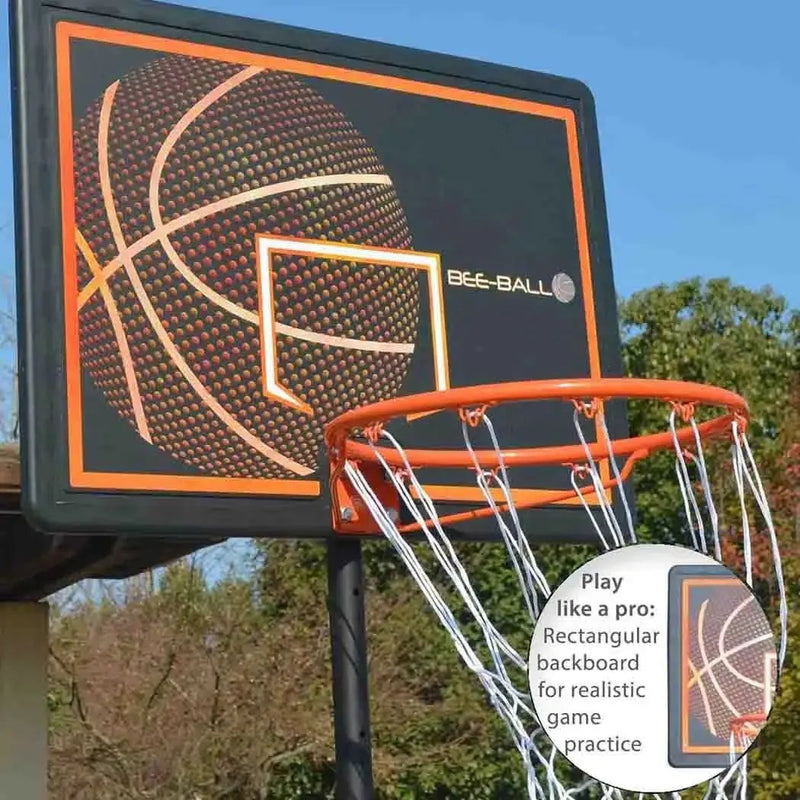
Large rectangular backboard (80cm x 58cm): At this age, most shots hit the backboard before the ring. A larger board means more successful rebounds into the hoop, which keeps young players motivated.
UV-resistant PE backboard: Built for British gardens. The board won't crack, fade, or warp through a UK winter or a rare hot summer.
Fillable base with front wheels: Fill with sand or water for stability, then tip and roll to move it out of the way. Practical for smaller gardens where the hoop needs to move for mowing or storage.
38cm hoop diameter: Wide enough to accommodate most junior ball sizes, so you're not limited to one specific ball.
Start at the lowest setting (1.6m) for ages 4-5. This lets very young children focus entirely on the shooting motion rather than straining to reach the ring. As they grow and their form improves, raise it in small increments. By age 8-9, most children will be shooting comfortably at the BB-05's maximum of 2.1m.
When to move up: If your child is consistently making shots from distance with good form at 2.1m, they're ready for the next model.
This is the age group most parents get wrong. A child of 10 or 11 who has been playing for a few years wants to feel like they're playing "real" basketball, and the temptation is to jump straight to a full-size 10ft hoop. Resist it.
Research from Nike Basketball Camps shows that children who move to regulation height before their strength and technique are ready end up compensating by throwing the ball rather than shooting it. That compensatory motion is one of the hardest habits to correct in later development.
The sweet spot for ages 9-12 is 2.4m to 2.75m (roughly 8 to 9 feet). This is challenging enough to feel like a step up, but achievable with proper form.
The Bee-Ball Pro Impact is designed specifically for this transitional window. It extends beyond the BB-05's 2.1m ceiling, reaching up to 2.6m (8.5ft), which sits squarely in the recommended range for this age group.
Key differences from the BB-05:
Greater maximum height: At 2.6m, it challenges older juniors without pushing them to compensation shooting
Larger, more robust construction: Better suited to the harder, faster play that comes with older children
Portable stand with wheels: Maintains the practical garden-friendly design for UK driveways and patios
A note for parents of sporty 10-11 year olds: If your child is physically strong and already shooting well at 2.1m, the Pro Impact gives them room to grow without the developmental risk of jumping to full regulation height too soon. The extra 50cm matters more than it sounds.
Once a child reaches secondary school age (Year 7 and above), the move to regulation 10ft (3.05m) makes sense. By this point, most children have the strength, coordination, and technique to shoot properly at the official height.
Playing at 3.05m also prepares them for school and club basketball, where regulation height is standard.
The Bee-Ball range offers two full-size options at this level, and the difference between them is worth understanding.
The Pro Level reaches the full 3.05m with a 110cm x 70cm backboard, significantly larger than the BB-05's entry-level board. It uses a screw-lifting and telescoping adjustment system, making height changes straightforward.
This is the right choice for:
Teenagers training seriously for school or club basketball
Families where multiple age groups will use the hoop (set it lower for younger siblings, full height for teens)
Anyone wanting a genuine regulation experience without the premium price of the Ultimate
The Bee-Ball Ultimate is the flagship model, and it earns the description. It reaches the same 3.05m regulation height, but upgrades across the board:
110cm x 75cm XL backboard: The largest in the Bee-Ball range, offering a more authentic rebound experience
Easy-Turn Crank Handle: Infinite height precision via a rotating handle, no tools needed. Adjust from junior height to full regulation in seconds
Pro-style rim: Designed to replicate the feel of a professional hoop
Heavy-duty construction: Built for the kind of daily use that comes with a garden court that actually gets used
The crank handle is the real differentiator. If you have children of different ages sharing the same hoop, being able to adjust height without removing bolts or tools is genuinely useful. Set it to 2.1m for the eight-year-old, crank it to 3.05m for the teenager, in under a minute.
Is the Ultimate worth the extra cost over the Pro Level? If you're buying one hoop for the long term, and particularly if multiple children will use it at different heights, yes. The crank adjustment alone saves significant frustration over the years.
Most basketball hoop buying guides are written for American driveways: wide, flat, often concrete, with a mild climate. UK buyers face different conditions, and a few considerations deserve specific attention.
The British climate is the enemy of cheap basketball hoops. Damp winters, UV exposure in summer, and frequent rain cycles cause untreated steel to rust and cheap backboards to crack and fade within a season or two.
Every Bee-Ball stand in the range addresses this directly:
Powder-coated steel poles: The coating prevents rust from forming even when the paint chips, which it inevitably will with regular use
UV-resistant polyethylene (PE) backboards: Won't crack or discolour under sun exposure, and won't become brittle in cold weather
Weatherproof nylon nets: Standard on the BB-05; for maximum longevity, consider upgrading to a heavy-duty chain net, which is virtually weatherproof and lasts far longer than nylon in outdoor conditions
One annual maintenance tip: Apply automotive wax to the steel pole once a year. It causes water to bead off rather than sit on the surface, significantly extending the life of the finish.
Every Bee-Ball stand has a fillable base for stability. You have two options:
Water: Easy to fill, easy to drain for winter storage. The downside is that water can freeze in a UK winter, which can crack the base. Add anti-freeze to water-filled bases if leaving outdoors through winter.
Sand: Approximately 45% denser than water, which means a noticeably more stable stand in high winds. Dry children's play sand works best; damp sand will clog the small fill hole. Many owners place unopened sandbags on top of the base as an additional weight rather than filling it.
Recommendation for UK gardens: Sand for stability if the hoop stays in one place; water if you need to drain and move it regularly.
UK gardens are, on average, considerably smaller than the American driveways these hoops are often designed for. The front-wheel design on Bee-Ball stands is a practical feature: even a fully weighted base can be tipped and rolled to clear space for mowing or to bring indoors during storms. For smaller gardens, this matters.
|
Model |
Height Range |
Best Age |
Key Feature |
|---|---|---|---|
|
BB-05 |
1.6m - 2.1m |
Ages 4-9 |
Large backboard, low entry height, budget-friendly |
|
Pro Impact |
Up to 2.6m |
Ages 9-12 |
Bridges junior and adult heights |
|
Pro Level (S003-19E) |
Up to 3.05m |
Ages 12+ |
Full regulation height, 110cm backboard |
|
Ultimate |
Up to 3.05m |
Ages 12+ / All family |
Crank handle, XL backboard, pro-style rim |
If you have a young child now but want a hoop that lasts until they're a teenager, the Bee-Ball Ultimate is the logical choice. Its crank adjustment system means you can set it appropriately for a six-year-old today and raise it to regulation height when they're fourteen, without buying a second hoop.
The counter-argument: a four-year-old doesn't need a full-size stand. The BB-05 is genuinely the right tool for young children, and its lower price point reflects that. Buying the Ultimate for a five-year-old is like buying adult football boots for a child who's still in reception.
The most common sensible path:
BB-05 for ages 4-9 (affordable, right size, grows with them through the early years)
Upgrade to the Ultimate at age 10-12 (covers the rest of their playing years at home)
The author : Emily Wilson
Emily Wilson is an early childhood educator, a mom of three and a toys and games enthousiast. She loves finding new ways to celebrate holidays and special occasions.
Technically yes, but two people make the job significantly easier and safer. The larger models (Pro Level and Ultimate) are substantial pieces of kit. Having a second person to hold the pole upright while you secure the base saves a lot of frustration. Assembly typically takes 2-4 hours; using a socket set or ratchet spanner rather than basic tools makes a meaningful difference.
It depends on the model:
BB-05 and Pro Impact: Telescoping pole system. Remove a bolt, slide the pole to the desired height, replace and tighten the bolt.
Pro Level: Screw-lifting and telescoping combination.
Ultimate: Easy-Turn crank handle. Rotate the handle to raise or lower the hoop to any height within the range. No tools required.
The fill hole is small (approximately 25mm). For sand, use bone-dry children's play sand and a funnel. Damp sand will clog the hole. For water, a standard garden hose fits the opening. If using water in winter, add anti-freeze to prevent cracking.
Usually caused by uneven ground or uneven weight distribution in the base. Check that the surface is level, and if using sand, ensure it hasn't shifted to one side over time. Redistributing the fill material typically resolves this.
Standard nylon nets last approximately 1-2 seasons with year-round outdoor use in the UK. For a longer-lasting solution, a heavy-duty zinc-plated steel chain net is virtually weatherproof and will outlast several nylon replacements. Replacement nets are available in the basketball accessories section.
Yes, provided you choose a portable stand rather than a wall-mounted or in-ground option. The front-wheel design on all Bee-Ball stands means you can move the hoop out of the way when not in use. The PE backboard also produces a "dead" rebound compared to acrylic or glass, meaning the ball doesn't fly off as far, which is a genuine advantage in smaller spaces.
The right hoop is the one that matches where your child is now, not where you hope they'll be in five years. Start with the correct height for their age and ability, prioritise a model with enough adjustment range to grow with them, and choose materials built for the British climate.
Quick decision guide:
Ages 4-9: Bee-Ball BB-05 - the right height, the right size, the right price
Ages 9-12: Bee-Ball Pro Impact - the transitional model that bridges junior and adult heights
Ages 12+: Bee-Ball Ultimate for the crank adjustment and XL backboard, or the Pro Level for full regulation height at a lower price point
Mixed-age families: Bee-Ball Ultimate, adjusted to suit whoever's playing
Browse the full Bee-Ball basketball hoops and stands range at Big Game Hunters, with free UK mainland delivery on orders over £50.